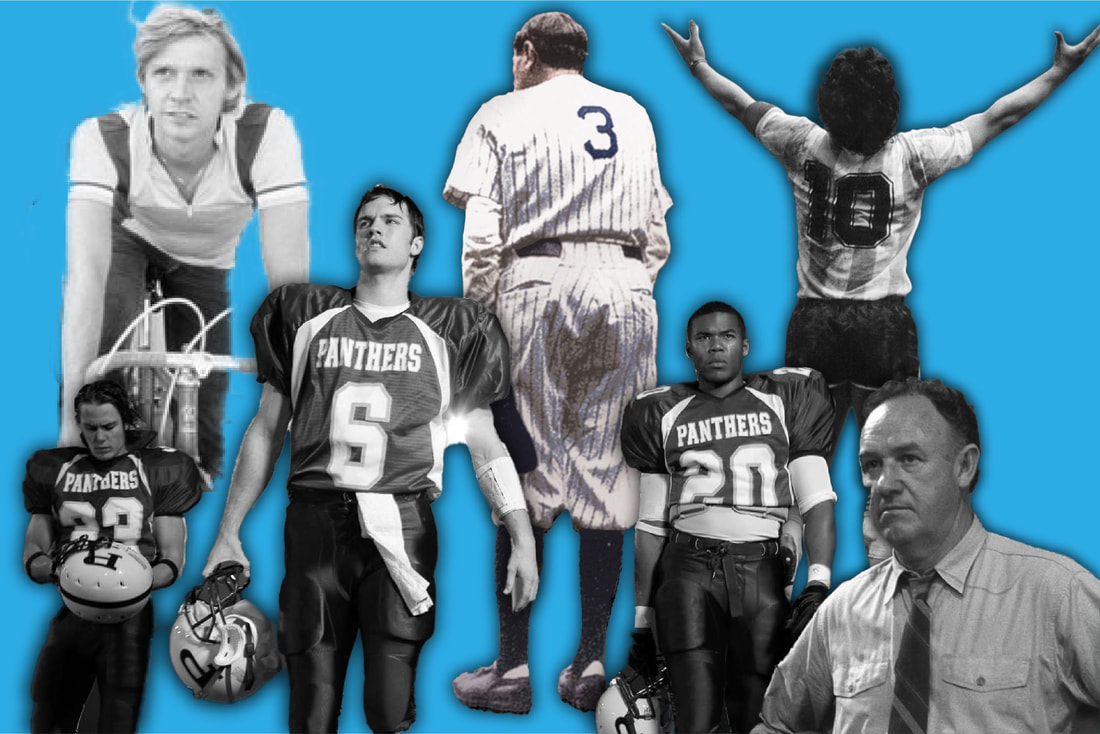
 I don’t want to count scalps but I’d like to hear from any film production publicist who worked on more sports movies than I did. Let me count the ways: American Flyers (bicycle racing), Major League, Cobb, The Babe, Torre, The Sandlot (baseball), Tin Cup (golf), Blue Chips (basketball), Ali (boxing), Rush (auto racing).
What was my fascination with sports movies? The same as my passion for sports and movies: I liked character and drama. We may not have much in the way of team sports this year. Very difficult to think of a team sport aside from cricket wherein you can maintain enough distance not to sweat or breath on someone. I’ll miss team sports. But if, like me, your passion for sports is about characters and drama, maybe you’ll want to flip the channel from ESPN reruns of NBA finals and NFL playoffs and see your team through someone else’s eyes. Sometimes, a movie can capture the spirit of sport in a way that the event itself can’t. In this time of cancelled and aborted sports seasons, when live events can’t be attended live and most sports figures are benched for the year, why not try some of these to get you through: BASEBALL – miss baseball? No better place to place your National Pastime nostalgia than Ken Burns’ 22 hour documentary masterpiece tracing the game’s on-field drama and panoply of personalities from its Civil War origins through its civil rights reckoning and into modern times. Runners up: BULL DURHAM, FIELD OF DREAMS. Kevin Costner is an athlete. FRIDAY NIGHT LIGHTS – miss football? This underrated movie was good but the TV series was even better. Football hasn’t lent itself to as many fictional re-creations as baseball but there are still some movies that can fill your empty Monday nights. My personal favourite: HEAVEN CAN WAIT (get past Warren Beatty’s limited athleticism as a quarterback). Backup: Oliver Stone’s ANY GIVEN SUNDAY. HOOSIERS – missing basketball? This one’s not just a great sports movie but a film classic with Gene Hackman at the top of his game. No shortage of All-Star backups: Spike Lee’s HE GOT GAME, the documentary HOOP DREAMS and my personal favourite WHITE MEN CAN’T JUMP. The new Netflix series THE LAST DANCE is also worth watching. MARADONA – missing world football/soccer? Considering it’s the most popular team sport in the world, soccer hasn’t seen a lot of screen time. This documentary about one of The Beautiful Game’s most accomplished and controversial players is a great one. Slim pickings after that with DAMNED UNITED the best drama and the girl-power pic BEND IT LIKE BECKHAM a fun watch. BREAKING AWAY – missing bicycle racing? Not always thought of as a team sport, it’s nonetheless going the way of other team sports during the Covid crisis. And there are a couple of excellent movies here, starting with this coming of age classic. If you want to go to the darker side, the documentary THE ARMSTRONG LIE is a winner. I’d also put in a fist pump for AMERICAN FLYERS, with Kevin Costner again showing his sports chops.
0 Comments
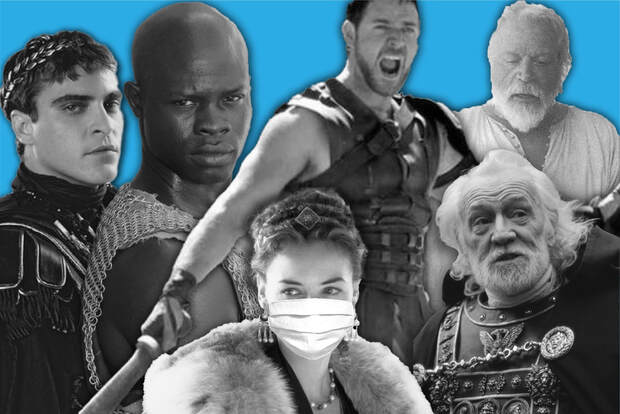 With the 20th anniversary of the release of Academy Award-winner Gladiator this month, there has been some speculation – and even filmmaker hints – about a sequel or prequel in the planning. As studios grapple with the questionable future of epic films, a fly on the wall at a production meeting for the sequel reports on how a second Gladiator movie might be made in today’s new normal.
Day 5 of 25 days filming. A conference room filled with legally-distanced men and women decked out in personal protection gear that looks designed for the crew of a pirate ship. The first assistant director addresses the gathered. Alright, everybody settle in. Masks, gloves, goggles in place? Kevin, your antiseptic spray bottle is not a squirt gun. Put it down. Okay. It’s a little unusual to have a production meeting at the end of our first week filming but the insurance bonding company would like us to go over a few issues of compliance. Ridley is listening from his caravan. Albert, you have him on monitor? Those in front, confirm to everyone in back Ridley is waving hello. You all know we’re on a tight schedule with a small crew… Who said that? If you’re old enough to remember that a movie this size used to be made on a 100 day schedule with a crew of 400, you’re too old to be working. Hey, wiseass, none of your business how Ridley’s age skews the bonding company’s curve. Complaints about lunches: The American catering company had been disinfecting with bleach. In the food. They’ve been fired. If you touch a box lunch, you own it. Dieters, do not give away your desserts. Grip department: No handing off equipment. Put it down, wipe it down, back away when the other guy picks it up. The social distancing inspector has noticed more violations in your department than any other. Anyone who can’t catch and throw should be replaced. Kevin, hold up your boom mic. Everyone see Kevin’s boom? That’s two metres. Anyone confused about social distancing, ask Kevin to show you his pole. A few things. How long did it take to wipe down a thousand cardboard extras in yesterday’s Colosseum scene? Too long. We’re scrapping the cardboard extras. And we’re scrapping the Colosseum. It’ll all be green screen. Extras casting, we’ll need another two dozen bodies for visual effects to replicate. Of course, one at a time. What do you think this is, 2019? Sizes, shapes, colours? Ridley? He’s shaking his head. Casting, work with costumes, see what you can come up with. Costumes, that means a little more work for you and your assistant. The two of you are already pulling sixteen-hour days? So what? You have a party to go to? Another note for costumes: the wardrobe safety inspector reported that Russell’s gladiator hazmat suit doesn’t conform to standards. Yeah, I know they’re wanting hospital standards but that’s what’s in his contract. Roger, I understand the face guard is reflecting. Maybe you can put a little more gel on the lens, soften the focus a bit. Work together – from a distance - figure it out. Wait. Ridley’s saying something. Why can’t I hear? There’s an issue with the director’s microphone. Kevin, go to his caravan and see what’s wrong. Who said that? The vehicle safety inspector. What do you mean, he can’t go in there until he’s had a shower? The meeting ended. A naked sound engineer fixed the director’s microphone. The costume designer quit and was replaced by the head of extras casting who sent an email to her background actors informing them they would be performing in their underwear. Costumes would be graphically added in post. Russell waived his contractual right to a hazmat suit after the camera operator agreed to wear one and the boom operator extended the length of his pole to ten metres. A half-day’s shooting was lost when the sole hairdresser went down with symptoms. The love scene had to be shot with the leading lady in a hijab and the leading man in a leather helmet. With no days left on the schedule, the climactic battle scene was pared down to a cage fight. Each actor was filmed separately. The movie was released in thousands of theatres worldwide to sold-out half capacity audiences. The first annual Zoom Oscars drew record-breaking television viewers and went without a hitch – except for a few incidents of hacking, one of which involved a confused Warren Beatty giving the Best Picture Award to a horror film entitled Glad He Ate Her Too. A new envelope was carefully sanitized before being delivered in the form of a paper airplane and, once again, Ridley Scott’s epic Roman Empire drama won the big prize. To all the doubters who said, ‘they can’t make blockbuster epics anymore,’ we answer… We’re still checking the science. At the end of our last day of filming in Dubai, the production joined the government of this city-state to celebrate completion of the first major western film to shoot here. The President’s beachfront palace was transformed into a private club where the Emirates’ elite and a raggedy bunch of film crew were thrown together to violate every prohibition in Islam.
I’m not much of a party person but I was determined to stretch my limits for this one. I lasted ‘til 3:00 a.m. Many of our crew stayed to watch the sun rise.As determined as I’d been not to wimp out on the wrap party, I was equally resolved not to waste our last day off in Dubai nursing a hangover. I awoke around 9:00 a.m., not feeling too much worse for wear, grabbed a quick breakfast and got in my car. I had only the vaguest idea of where I was going. I only knew I wanted to see what lay beyond the gates of Oz. I drove south, past the desert, through the mountains, along the Gulf. In Bernardo Bertolucci’s The Sheltering Sky, Debra Winger’s character poses the question, “What’s the difference between ‘travelers’ and ‘tourists.’” A tourist, her companion says, is someone who thinks about going home from the moment he arrives, whereas “a traveler might not come home at all.” Nicola was more of a traveler than I was. Journalism wasn’t a job for her, it was a passport. She went places simply to see them and frequently changed her return ticket because she felt she hadn’t explored enough. She had the ability to completely disconnect from where she lived in order to inhabit where she was. It was a spirit I admired, if not one I could always fully embrace as I’d gotten older and more “responsible.” I used to travel alone a lot in my youth. I’d get in a car and drive for days, weeks, the entire summer, stopping someplace and imagining I lived there. Film locations were more like being with a tour group. But in my earlier years, I’d sometimes fly off on my own when the movie wrapped, to explore places like Cairo, Bejing, Bangkok. I knew nothing about Oman except the name of its capital city and its national religion. Was it friendly to westerners? Was it dangerous? Was it even interesting? I didn’t care. I just wanted to get lost. Border crossings still excited me. Real borders. Land borders. Where your destination is just over the horizon. International travel usually involves airports and passage through passport control opening to a world of duty free shops in temperature regulated lobbies. There is no sense of entering someplace with a different landscape, a different culture. All you know is you’re not in the air anymore and people are speaking English with an accent. The border patrol office at Oman was empty except for one man behind the customs desk. Unfortunately, bureaucracy is the same everywhere and he sent me back to the Dubai side to get an exit visa and an entry stamp. Or was it an entry visa and an exit stamp? I also had to buy car insurance. With all my stamps affixed I made a u-turn at the Welcome to Dubai sign and returned to Omani customs. I was still the only visitor there. The man at the counter asked the purpose for my visit. “Just a day trip,” I told him. At that, the customs agent, who hadn’t really looked at me, looked at me. “Enjoy your trip,” he handed me my passport with a smile that seemed to say I-know- you’re-CIA-but-what-the-hell. About thirty minutes from the border kiosk, I left the highway and drove along narrow paved roads through small towns that had the single-story architecture Dubai had bulldozed for highrises. I hadn’t thought to bring water so I stopped at a store with a hand-painted sign above the door – in Arabic, of course - and a picture of an ice cream bar in the window. It was the commercial centerpiece in a village that had a banana stand, something that might have been a laundry and not much else. It was then I realized how ill prepared I was for this journey. I had no Omani money and they didn’t take credit cards. I also didn’t know a word of Arabic. The shopkeeper stared. I put the water down with a helpless shrug and started to leave. “Dollar?” he said. I pulled out a dollar and he smiled. “OK,” he said. Outside the store, a group of boys in traditional dress had gathered. One touched my pants and I restrained an instinct to guard my wallet. The biggest boy put his hand in the air and grinned. I gave him a high five. They followed me back to the car like I was a rock star. Or at least an oddity. I cruised along the side roads, passing through villages and neighborhoods that might never have seen a westerner. I was struck by how clean they were. No candy wrappers, paper bags or drink cans. Funny to notice the absence of something. The noon call to prayer sounded and I passed solitary figures on rugs laid down along a sidewalk or dirt track. I was hungry and four hours’ sleep was catching up to me. I drove until I spotted a store with men in dishdashas sitting outside, drinking coffees. I parked my car and walked in. The customers turned in unison. The man behind the counter was stern. I pulled out a couple of dollars and pointed to a pastry. He shook his head. Resigned, I started back out. He followed me to the door. The men outside shuffled in their seats as I exited. The proprietor exchanged words with them. The proprietor shouted something in Arabic. He shouted a second time. I listed my options: keep walking, run, turn around. I turned back to him. He went into his shop and came out a moment later with my pastry. “Salaam Alekem,” he said with a slight bow. “Alekem Salaam,” I bowed to them all, pressing my hands together. I’d met a charming Omani Prince and his sister at the wrap party and he’d given me his phone number. “Call if you ever get to Muscat,” he said. I had the Prince’s phone number in my shirt pocket. But I decided against going all the way to Muscat. I’d seen one modern Arab city and it was what I was trying to get away from. Another time, perhaps. I drove another hour through outlying towns with more goats than people, past date farms and olive orchards, then rejoined the highway and headed back to Dubai. It was a day trip and I had to return to my tour group. But for a few hours I was a traveler again. Most of my generation lost faith in the Nobel Committee when they bestowed the Peace Prize on Henry Kissinger.
The administrators of Alfred Nobel’s legacy have received deserved and undeserved criticism ever since and long before. I’m among those who thinks Robert Zimmerman’s Nobel Prize for Literature is not only deserved but overdue. For those disagree, let’s run through a few samplings from Prize-winning poets past. Consider the winner of the Nobel’s first prize for literature, Sully Prudhomme, 1901. At a time when Leo Tolstoy was still alive, the Committee gave him the award for his poetry. His most famous poem was the following (translated from French): The Broken Vase A fan’s light tap Was enough to chip This flower vase In which the roses Now are dying. No sound it made But a hairline crack Day after day Almost unseen Crept slowly round the glass And dropp by dropp The water trickled out While the vital sap In the roses’ stems Grew dry. Now no-one doubts: “Don’t touch”, they say, “It’s broken”. Often, too, the hand one loves May lightly brush against the heart And bruise it. Slowly then across that heart A hidden crack will spread And love’s fair flower perish. Nice, huh? Not quite War and Peace but nice. Here’s Robert Zimmerman from Visions of Johanna – hardly his most famous. Ain't it just like the night to play tricks when you're tryin' to be so quiet ? We sit here stranded, though we're all doing our best to deny it And Louise holds a handful of rain, tempting you to defy it Lights flicker from the opposite loft In this room the heat pipes just cough The country music station plays soft But there's nothing really nothing to turn off Just Louise and her lover so entwined And these visions of Johanna that conquer my mind. In the empty lot where the ladies play blindman's bluff with the key chain And the all-night girls they whisper of escapades out on the D-train We can hear the night watchman click his flashlight Ask himself if it's him or them that's really insane Louise she's all right she's just near She's delicate and seems like the mirror But she just makes it all too concise and too clear That Johanna's not here The ghost of electricity howls in the bones of her face Where these visions of Johanna have now taken my place. The last couplet alone is worth a prize. How about 1907 winner Rudyard Kipling. Probably his most famous is If: If you can keep your head when all about you Are losing theirs and blaming it on you, If you can trust yourself when all men doubt you, But make allowance for their doubting too; If you can wait and not be tired by waiting, Or being lied about, don’t deal in lies, Or being hated, don’t give way to hating, And yet don’t look too good, nor talk too wise: If you can dream—and not make dreams your master; If you can think—and not make thoughts your aim; If you can meet with Triumph and Disaster And treat those two impostors just the same; If you can bear to hear the truth you’ve spoken Twisted by knaves to make a trap for fools, Or watch the things you gave your life to, broken, And stoop and build ’em up with worn-out tools: If you can make one heap of all your winnings And risk it on one turn of pitch-and-toss, And lose, and start again at your beginnings And never breathe a word about your loss; If you can force your heart and nerve and sinew To serve your turn long after they are gone, And so hold on when there is nothing in you Except the Will which says to them: ‘Hold on!’ If you can talk with crowds and keep your virtue, Or walk with Kings—nor lose the common touch, If neither foes nor loving friends can hurt you, If all men count with you, but none too much; If you can fill the unforgiving minute With sixty seconds’ worth of distance run, Yours is the Earth and everything that’s in it, And—which is more—you’ll be a Man, my son! Comparisons are odious but for thematic similarities, try this one from Mr. Zimmerman. As pundits I normally respect - from Ann Thompson (Thompson On Hollywood) to Michael Fleming (Deadline Hollywood) - fall all over themselves in praise of Clint Eastwood’s American Sniper, I fall deeper into despair.
“Any viewing that doesn't take away at least in part an anti-war message is missing the point,” writes Thompson. “…It is more a character study… and that seems to be a core of its appeal.” Well, I’ve obviously missed “the point.” Maybe I watched a different version, but the film called American Sniper that I saw showed Iraqi men, women and children mowed down like targets in an arcade game because, well, they’re all out to get us. I mean ALL of them. Maybe that was the “point”: everyone over there hates us and wants to kill us. If that’s the movie Clint wanted to make, who am I to say he shouldn’t make it? My issue is with the brainy types in the media who praise it as an “anti-war movie” or even a “character study. Shortly after his introduction as a former cowboy, turned Navy Seal after watching the Twin Towers fall on TV, our Hero shoots a mother and child who are carrying a grenade. No hint is offered, before or after, as to why they might have wanted to blow up a troop of soldiers in the rubble of what used to be their village because, well, who cares? Ahh, but the character study unspools as our hero brushes off a congratulatory backslap in the aftermath. Sorry, that’s a cartoon not a character reveal. He might as well have shifted a cigar from one side of his mouth to the other. Am I missing the “point?” Audiences like their villains in black and heroes in white. I get that. But has the Eastwood mystique put Abu Ghraib-style hoods over the heads of all the smart people? Apparently, the movie envisioned by Steven Spielberg who originally bought and developed Chris Kyle’s book would have taken a more nuanced approach. One can only conjecture from media reports how it would differ, but interviews with the screenwriter (Jason Hall) indicated that Spielberg’s version would have at least made the rival Iraqi sniper a fully dimensional human being. Clint apparently had no interest in that. Eastwood provides a glimpse of a photo of the sniper standing on a podium receiving a sharp-shooting medal. That’s all we need to know about this character. He’s a good shot. Let’s move on to Rambo getting PTSD. It’s not just that there isn’t a single sympathetic Iraqi in the movie, there isn’t even an innocent victim of war (if you don’t count a father and son killed by a one-dimensional villain called The Butcher for talking to the Americans). The Iraqis are, as the American soldiers make a point of calling them, “savages.” Hey, kudos to Clint for making it clear what the American fighting man thinks of the local population. Did I miss the point again? An artist knows what kind of emotion he’s trying to evoke with his art. Was it Clint’s intention to make a movie for gung-ho morons who question nothing about this war? If so, why is the Hollywood intelligentsia lapping this up? All these smart people fawning over the artist Clint Eastwood and I feel like the kid who slept through the lecture. His brilliant action scenes? Anyone who knows filmmaking should know that the second unit director, Robert Lorenz, shoots most of the action sequences. Surely, the praise is for Clint’s complex character study in which our Hero never questions his mission or learns anything from his experience. After 160 kills, his only regret is he couldn’t go back and kill more. I wasn’t surprised to read how Sarah Palin loved this film. It’s got her sensibilities written all over it. But I’m questioning the smart kids in the class - the Thompsons, Flemings, even Jane Fonda who recently sent out a “Way to go, Clint” Tweet. She compared American Sniper to Coming Home. Get a grip, Jane. A $105 million opening weekend would indicate a lot of people are up for seeing American troops kill people – Nazis, Gooks, Ragheads, name your favorite savage. That’s what war does I suppose: force the combatants to dehumanize the other side. But in a better movie like Jarhead we were witness to the dehumanizing process. And it wasn’t heroic. As an American living overseas, I think American Sniper exemplifies the worst aspects of my country and its cultural exports. If the “point” of this movie is anti-war, I’m completely missing the point. And if there’s a complex character in American Sniper, I guess I missed him too. |
Anything and Everything that has Nothing to Do with the Movies
ROB HARRIS
Sometimes, we go to a movie to get away from the world and sometimes we go to see what’s going on in the world. This blog will offer comments on the world, the movies and their occasional overlap.
archives
July 2020
|
 RSS Feed